Roof repair and replacement across Vancouver, WA 98660
Vancouver roofs range from century-old bungalows near downtown to 1990s cedar shake on the east side, and each part of town wears out its roof in a different way.
Vancouver, WA at a glance
- ZIP codes
- 98660, 98661, 98662, 98663, 98664, 98665, 98682 to 98686
- Common homes
- Early 1900s bungalows, mid-century ranches, 1980s to 2000s tracts
- Roofs we see most
- Architectural composite, aging cedar shake, low-slope additions
- Weather to plan for
- Steady winter rain, Gorge east wind, occasional ice storms
- Nearest office
- Vancouver office, 610 Main Street
Our main office sits at 610 Main Street downtown, so most of the city is a short drive for our crews. We work on steep Craftsman roofs a few blocks from Esther Short Park, the low ranches of central Vancouver, and the big composite roofs of Cascade Park and Fishers Landing. The city grew outward from the river, and the roofs follow the age of each ring: oldest near the water, newest along the north and east edges.
Rain is the constant here. Roughly 40 inches falls in a typical year, most of it between October and May, and it rarely stops long enough for a shaded roof to dry. Add tall Douglas firs and a cold east wind out of the Gorge, and you get the three problems we fix most often: moss, wind-lifted shingles and slow leaks at flashing.
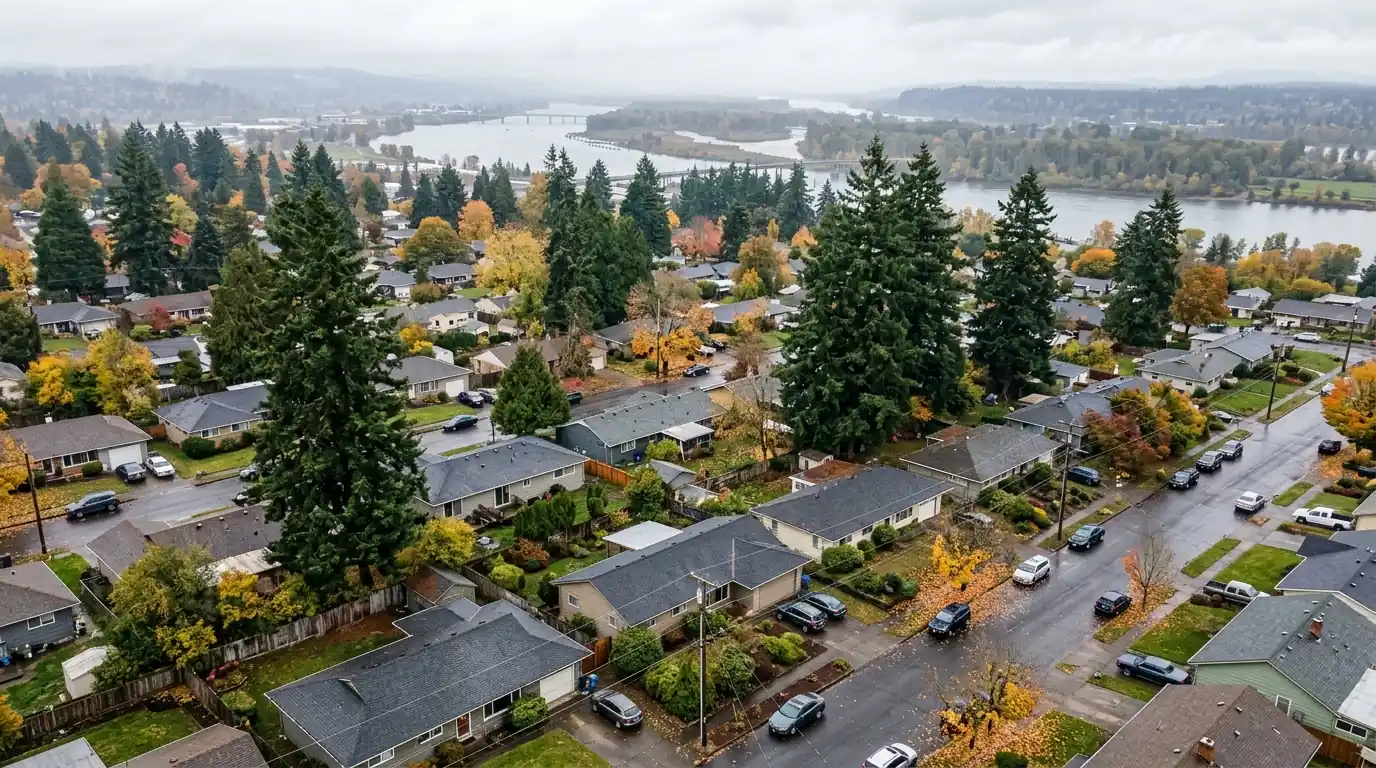
How Vancouver roofs change from downtown to the east side
Start near the river and work outward. Hough, Arnada and the blocks around Esther Short hold the oldest houses: steep pitches, boxed eaves, brick chimneys and, under the current shingles, often two or three older layers. Central Vancouver, including Minnehaha, Walnut Grove and Bagley Downs, is mostly mid-century ranch homes with shallow pitches and the occasional flat-roofed addition. Past I-205 to the east, Cascade Park, Fishers Landing, Sifton and Five Corners fill with 1980s to 2000s subdivisions, many built with cedar shake that has now reached the end of its life.
North of the city limits, Felida, Salmon Creek and Mount Vista have newer homes with complex rooflines, lots of valleys and dormers, and those roofs are hitting their first replacement. Each group needs a different plan. A 1910 bungalow may hide skip sheathing under the shingles, while a 2004 two-story with eight valleys needs extra underlayment where the water concentrates. Knowing which is which saves money on tear-off, decking and flashing.
What Vancouver weather does to a roof over a year
October through May is the long wet stretch. Light rain for days at a time keeps shaded slopes damp, and moss takes hold on the north side within a few seasons. Its roots lift shingle edges and hold water against the mat. In fall and winter, east wind pours out of the Columbia River Gorge and hits the east side hardest, lifting tabs and peeling ridge caps. Ice storms are not common, but when one arrives it loads fir limbs until they snap onto roofs and gutters. Dry summers are the best time for replacements, and also when sun-baked south slopes start to show their age.
How we handle roof work across Vancouver
Every job starts with a look at the roof itself, not a guess over the phone. We check the decking from the attic where we can, photograph problem spots and walk you through what we found. Typical ranges help with planning: a moss cleaning and treatment often lands between $465 and $1,180, and a full composite replacement on a 2,000 square foot home runs about $14,850 to $27,300. Your real number comes after the inspection. We check with the city building department and pull permits where they are required.
What homeowners in Vancouver call us for
Roof Replacement
Thousands of Vancouver homes built in the 1980s and 1990s are on original roofs that have run out of life.
See the detailsMoss Removal & Roof Cleaning
Eight wet months a year let moss spread across shaded slopes faster here than in drier parts of the country.
See the detailsWind & Storm Damage Repair
Gorge east winds lift tabs and ridge caps across the east side every fall and winter.
See the detailsCedar Shake to Composite Conversion
Cedar shake from the 1970s to 1990s is splitting and cupping on many Vancouver roofs right now.
See the detailsRoof Leak Repair
Most leaks we trace in the city start at flashing, vents or valleys rather than the open field of shingles.
See the detailsGutter Cleaning
Fir needles fill Vancouver gutters every autumn, and overflow rots fascia and soaks siding.
See the detailsVancouver neighborhoods we roof
Each one gets its own page, because a 1920s Hough bungalow and a 1990s Fishers Landing two-story need different roofs.
Felida
Many Felida homes went up in the 1990s and 2000s, and their original composite roofs are now at the age where patching stops making sense.
Roofing hereSalmon Creek
Homes near the wooded Salmon Creek corridor stay damp longer than most, so moss, clogged gutters and slow eave leaks show up here before the shingles wear out.
Roofing hereHazel Dell
Hazel Dell ranches often carry two layers of shingles, an added patio cover or carport, and a roof line that has been changed more than once.
Roofing hereOrchards
Orchards mixes older homes on what used to be farm parcels with newer tract houses, so one street can hold a 1950s house, a pole barn and a 2005 two-story.
Roofing hereCascade Park
Cascade Park is full of 1980s and 1990s homes that went up with cedar shake, and most of those shake roofs are now splitting, cupping and growing moss.
Roofing hereFishers Landing
Fishers Landing sits at the far east edge of Vancouver near the Gorge, so the cold east wind reaches its roofs early and hits them hard.
Roofing hereMinnehaha
Many Minnehaha ranches still carry a brick chimney from their oil or wood heat days, and the flashing around it is where most of their leaks begin.
Roofing hereFive Corners
Five Corners has a dense mix of single-family homes, duplexes, townhome rows and rentals, so many roofs here are shared, managed or owned by landlords.
Roofing hereMount Vista
Mount Vista homes are some of the newest in the Vancouver area, and early care on their roofs now decides how long the first roof lasts.
Roofing hereLake Shore
Lake Shore homes sit near the open water and flat lowlands around Vancouver Lake, where storms arrive with little in their way.
Roofing hereWalnut Grove
Walnut Grove's mid-century ranches often still have old gutters and tired fascia boards, and the water damage at the roof edge is usually the first problem we find.
Roofing hereSifton
On Sifton's 1990s homes, the ridge line and the skylights are where wind and rain find their way in first, long before the rest of the roof gives out.
Roofing hereHough
Hough's older homes have steep roofs, brick chimneys and layers of past roofing, all set on narrow lots where every bundle and dumpster has to be planned.
Roofing hereBagley Downs
Bagley Downs ranches often hide a near-flat addition, enclosed porch or garage conversion behind the main roof, and that low section is where leaks start.
Roofing hereArnada
In Arnada, plenty of older houses have had their attics turned into bedrooms, and the dormers, skylights and knee walls added along the way decide how the roof behaves.
Roofing hereLincoln
Lincoln homes change owners often, and a buyer's inspection report full of roof notes is usually the reason people here call us first.
Roofing hereOld Evergreen Highway
Homes along Old Evergreen Highway are bigger and more varied than most of Vancouver, so the roofing questions here are about materials, upkeep and keeping a big, complicated roof in good order.
Roofing hereOgden
Many Ogden homes are on their second or third roof now, and more of them have solar panels that have to come off before any new shingles can go on.
Roofing hereRoofing questions from Vancouver
Do you cover every part of Vancouver, from downtown to Fishers Landing?
Yes. Our crews run out of the Main Street office downtown and work across the city, plus the unincorporated communities to the north such as Felida, Salmon Creek and Hazel Dell. East-side jobs near the Camas line are routine for us. Call (360) 803-6405 any hour and we will set a time to look at the roof.
How many days does a full reroof take on a house inside Vancouver city limits?
Most single-story ranches and two-story tract homes take one to three working days once materials arrive. Older downtown homes with several layers or damaged decking can take longer. We plan around rain in the forecast and close up the roof at the end of every day so a surprise shower never reaches the attic.
Is moss on a Vancouver roof a real problem or just cosmetic?
It is a real problem. Moss grows between and under shingle edges, lifts them and holds water against the roof for weeks during the wet season. Over time that speeds granule loss and leads to leaks. Removing it gently, treating the surface and adding zinc strips near the ridge slows regrowth on shaded slopes.
Nearby areas we also roof
Roof trouble in Vancouver?
Call any time. We will set a time to look and give you a straight price.