Vancouver, WA torch-down roofing for flat roofs and decks
An older torch-down roof is cracking, its granules are washing off, and the seams where two rolls meet are starting to lift at the edges.
- 24/7 phones
- New roofs and materials
- Vancouver office on Main St
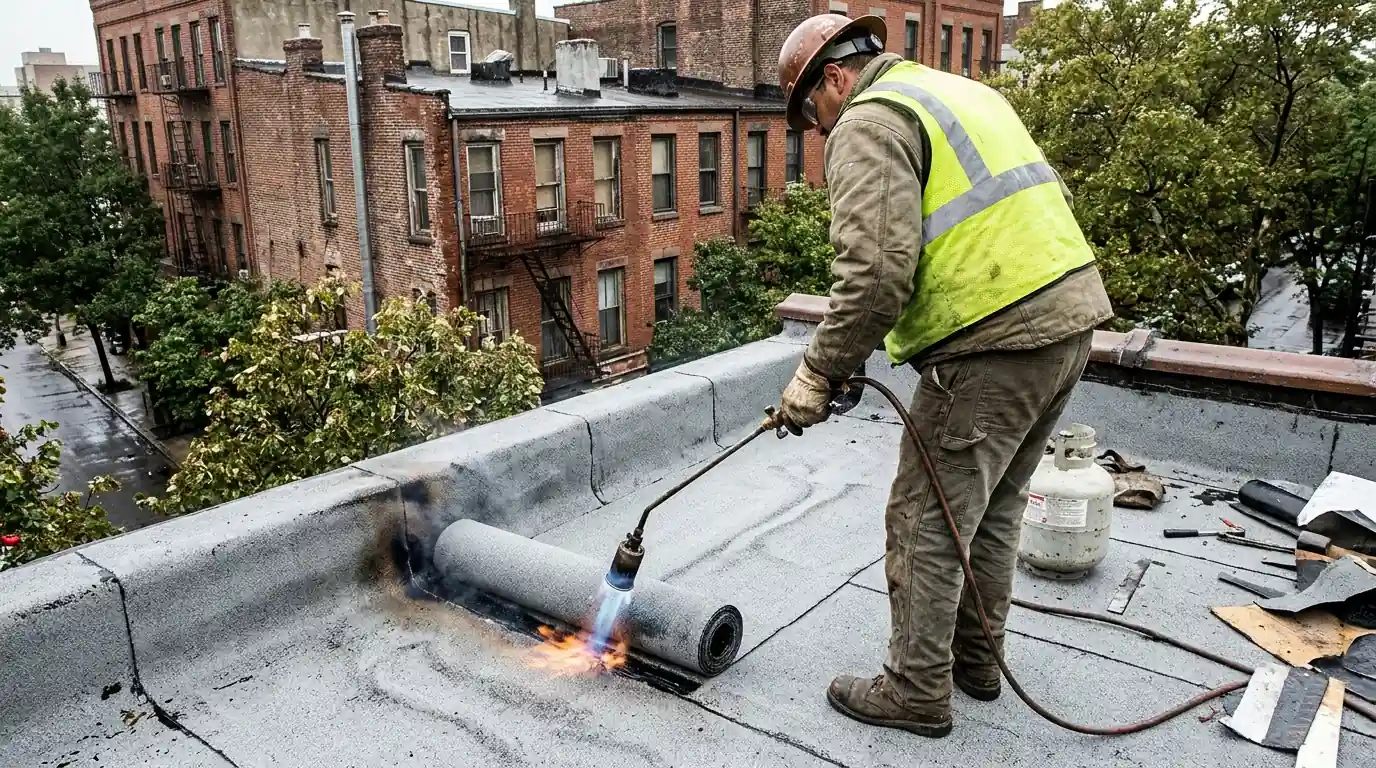
Torch-down is a good fit for flat roofs that see foot traffic, decks over living space and small roofs with a lot of penetrations. It is durable and easy to repair. The downside is the open flame, so it needs trained installers, a fire watch, and in some spots a self-adhered sheet instead of torching close to wood.
Torch-down roofing is modified bitumen, an asphalt-based sheet reinforced with polyester or fiberglass, that is melted onto the roof with a propane torch. As the underside melts, it fuses to the layer below and to itself at the laps, creating a thick, tough membrane. It handles foot traffic better than most single-ply sheets and is common on older flat roofs, roof decks and small porch roofs in the region.
Our crews install torch-down as a two-ply system: a base sheet followed by a granulated cap sheet. We also repair existing torch-down roofs by heating and re-fusing lifted laps or adding a patch ply. Because the work involves open flame on a building, our roofers follow a set safety routine every time, and we decline to torch near materials that could catch.
How a two-ply torch-down roof is built
A torch-down roof starts with a clean, dry deck and, on most homes, a layer of cover board or insulation fastened down first. The base sheet goes on next, either torched or mechanically fastened, depending on what lies below. The cap sheet follows, with its laps offset from the base sheet laps so no seam lines up. Each lap gets a visible bead of melted bitumen squeezing out, which is how our roofers confirm a full bond.
Edges and walls get special care. The cap sheet runs up walls onto a cant strip so it never bends at a sharp right angle, then gets covered by metal counterflashing. Drains are set in a lead or metal flange and flashed in layers. Granules on the cap sheet protect the asphalt from sunlight, so we keep loose granules handy to broadcast into any fresh bleed-out at the laps, so no black asphalt is left exposed.
Fire safety on every torch job
Torching is safe when it is done with discipline, and dangerous when it is rushed. Our crews treat fire safety as part of the job, not as an add-on. Near wood siding, skylight curbs and eaves where heat could reach hidden material, we switch to self-adhered membrane rather than risk it. That rule costs a little more in material but removes the main fire risk on residential work. Safety steps are never skipped to save time.
- Charged extinguishers on the roof at all times
- No torching directly against wood or into gaps
- Self-adhered sheet near siding and eaves
- Fire watch for an hour after the last torch
- Infrared check of edges before leaving
- Propane cylinders stored and secured properly
Repairing an existing torch-down roof
Torch-down holds up well, but it does age. Granules wear off in foot paths and in spots where water ponds, exposing the black asphalt to sun, which then dries and cracks. Laps lift where the original installer did not get full bleed-out. Blisters appear where moisture was trapped during installation. Most of these can be repaired by cutting out the damaged area, priming the surface and fusing a patch over it.
We check whether the old roof can take a new cap ply over the top. When the base layers are firmly fused and dry, adding a fresh cap sheet can extend the roof's life at a lower cost than a full tear-off. If moisture probes show wet insulation or the roof already has too many layers, tear-off is the only sound choice. We show you the probe readings that support either decision.
Torch-down compared with single-ply
Owners often ask whether to choose torch-down or a single-ply membrane like TPO. Torch-down is thicker and stands up better to foot traffic, dropped tools and furniture on a deck. TPO is lighter, reflects more sun and goes on without flame. For a deck or a roof that people will walk on, we usually favor torch-down or a deck-grade PVC. For a roof that no one walks on, single-ply is often the simpler and lower-cost choice.
Signs your torch-down roof needs work
Bare black patches
Spots where the granules have washed off leave the asphalt exposed to sun, and cracking soon follows.
Lifting seam edges
Laps that can be lifted with a fingernail were never fully fused and will let water in under wind.
Blisters underfoot
Soft, raised bubbles show moisture trapped between plies, which can split open after a cold night.
Cracks at wall bends
Splits where the sheet turns up a wall usually mean no cant strip was used or the flashing has shifted.
Leaks near drains
Water stains below a drain point to a failed flange or cracked membrane at the outlet.
Patched and patched again
Many overlapping repairs signal the roof has reached the point where a new cap or tear-off is needed.
How we handle torch-down roofing
Inspect and probe
We check laps, granule cover, blisters and flashings, and take moisture readings to see whether the insulation is dry.
Choose the scope
We price a repair, a new cap ply or full tear-off, and explain which one the readings and condition support.
Set up safely
Extinguishers go on the roof, combustible areas are marked for self-adhered sheet, and propane is staged and secured.
Lay base and cap
The base sheet and cap sheet go on with offset laps, full bleed-out at seams and flashed walls, drains and penetrations.
Fire watch and finish
We stay on site for a fire watch, scan edges with an infrared thermometer and clean up before leaving.
Typical torch-down roofing costs
Torch-down is priced by roof size, number of layers coming off, how many walls and penetrations need flashing, and access for materials. These typical ranges reflect residential roofs around Vancouver. The real number depends on what we find during the moisture check, especially whether old layers are wet and need to come off.
| Job | Typical range |
|---|---|
| Lap or blister repair | $435 to $1,240 |
| New cap ply over sound roof | $3,180 to $7,460 |
| Full tear-off, two-ply system | $6,920 to $16,850 |
Wet insulation, multiple old layers, tight access and many wall flashings push torch-down prices higher. See every service side by side in the roofing price guide.
Torch-down on older Vancouver flat roofs
Older homes and small commercial buildings near downtown Vancouver, around Esther Short and along the older blocks near Hough, often have flat sections or roof decks that were done in torch-down or built-up roofing years ago. Many of these roofs sit right against wood-framed walls and trim, which is why our crews lean on self-adhered sheets in the tightest spots. Long winter rains find any open lap, and needles from street trees pile up at the low edges and hold water against the laps for weeks.
In winter, cold mornings can make the sheet stiff and slow to bond. We schedule torch work for dry windows and wait for the deck to be fully dry, because torching over damp wood traps moisture that becomes a blister later. If a project has to happen in the rainy season, we may tarp the roof for a day or two and run fans or heat to dry the deck before starting. On very tight urban lots we also plan where the propane and materials will stage so sidewalks stay clear.
Torch-Down Roofing questions
Is torch-down roofing safe on a house with wood siding?
It is when crews follow strict rules. We never torch directly against wood or into gaps where heat can travel. Near siding, eaves and curbs we use self-adhered membrane instead. Extinguishers stay on the roof, and we keep a fire watch after the last torch is turned off.
Can a new torch-down cap sheet go over my old flat roof?
Sometimes. If the existing roof is well fused, dry and not already layered too thick, a new cap ply can be added. If moisture readings show wet insulation, or the roof has failed widely, tear-off is the right call. We take readings before recommending either.
How long does a torch-down roof repair take?
Most lap and blister repairs take a few hours, including setup and the fire watch afterward. Larger patches or flashing rebuilds at walls can take a full day. We plan torch repairs for dry weather so the surface bonds properly and moisture is not sealed in.
Is torch-down good for a rooftop deck over a bedroom?
It is one of the better choices because it is thick and resists foot traffic. For a deck, we add a protective layer such as pavers on pedestals so furniture does not wear the cap sheet. Good drainage and solid wall flashings matter more than anything else on a deck over living space.
Work that often goes with it
Flat & Low-Slope Roofing
TPO, PVC, EPDM and modified bitumen roofs for flat and low-slope sections, with drainage fixes so water stops ponding.
See the detailsCommercial Roofing
Repairs, recovers and replacements on low-slope and steep commercial roofs, from strip malls and offices to shops and warehouses.
See the detailsRoof Leak Repair
Leak tracing and repair for stains, drips and attic moisture. We follow the water back to where it actually enters the roof.
See the detailsTorch-Down Roofing around Vancouver
Our crews do this work across Clark County and the Portland side, including:
Call about torch-down roofing
Phones are answered 24/7. Tell us what you are seeing and we will set a time to look.