Seamless gutters made on site for Vancouver, WA homes
Old sectional gutters leak at every joint, sag between hangers and spill water down the siding and into the crawlspace every time a heavy rain comes through.
- 24/7 phones
- Gutters, skylights and roofline
- Vancouver office on Main St
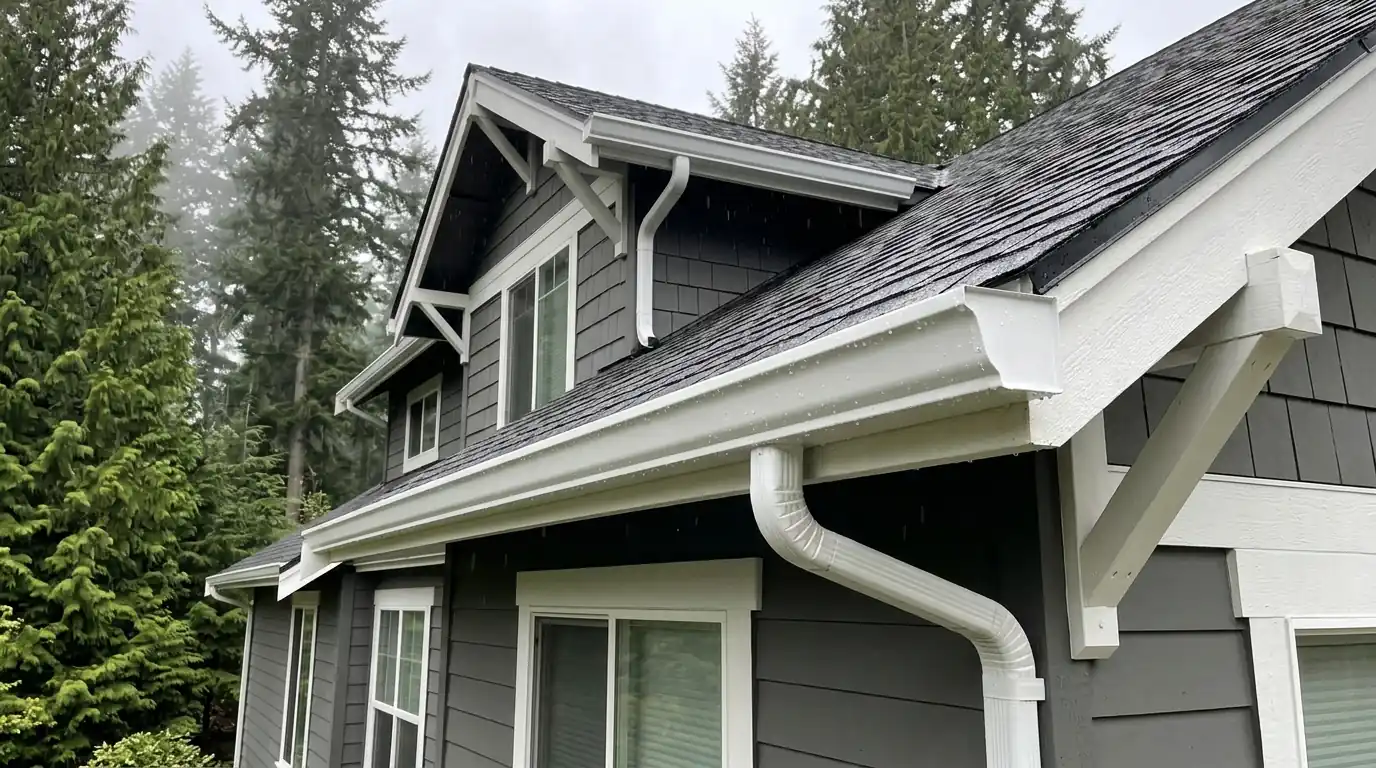
Seamless gutters are made on site in one continuous length per eave, so they have no seams along the run to leak. Most homes here get 5-inch or 6-inch K-style aluminum with hidden hangers. Six-inch gutters with 3 by 4 downspouts handle Northwest downpours and fir needles better and are worth it on larger or steeper roofs.
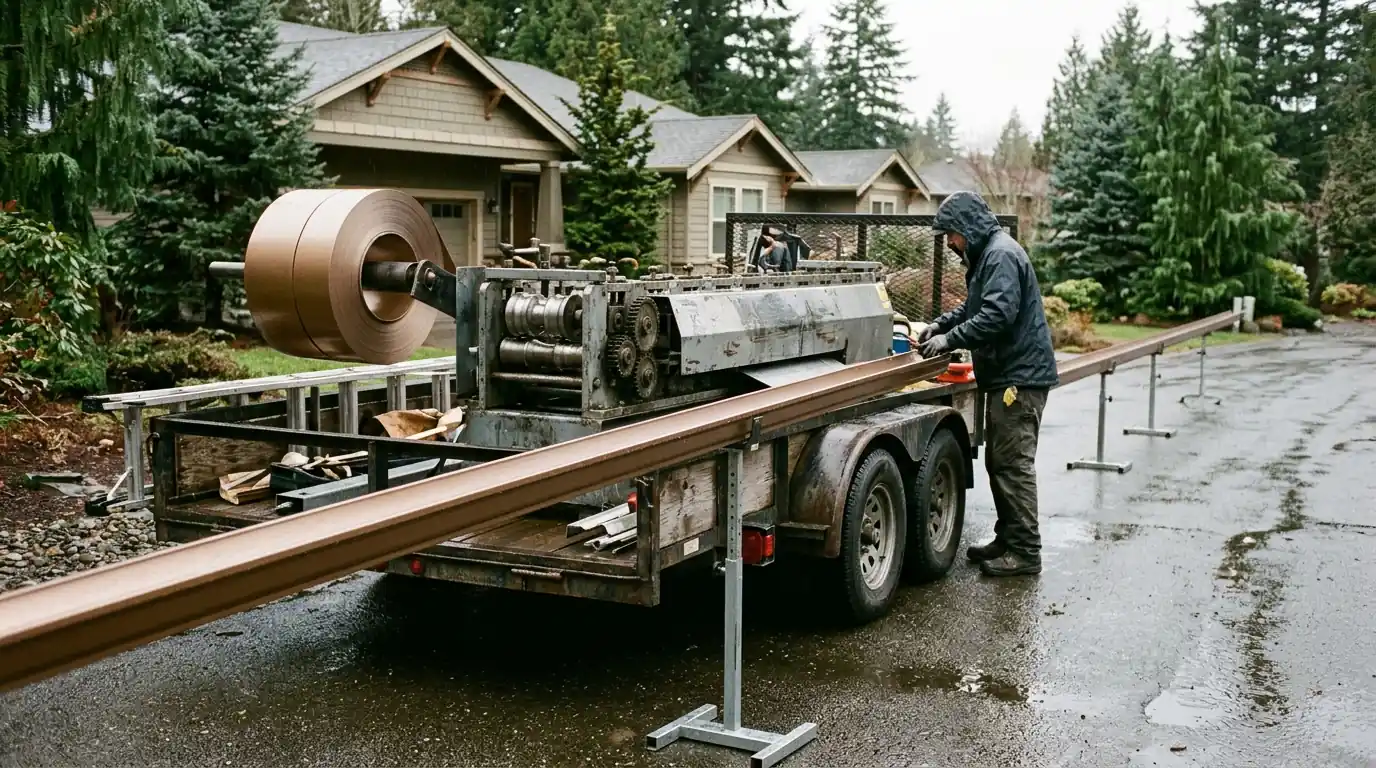
Seamless gutters are made from a coil of aluminum run through a machine in our truck, right in your driveway. Each run comes out as one piece the full length of the eave, so the only joints are at the corners and outlets. Fewer joints means fewer places to drip, and fewer places for needles and grit to catch and start a clog.
A new gutter system is more than the trough itself. We look at how much roof drains to each run, where the downspouts should go, and where that water ends up on the ground. Gutters that dump at the foundation still cause basement and crawlspace trouble. We plan outlets so the water leaves the house through extensions or tie-ins you already have.
Sizing gutters for long wet winters
Gutter size depends on how much roof drains into each run and how steep that roof is. A steep slope sheds water faster, so the gutter has to catch a bigger surge. Many older homes here have 5-inch gutters with small 2 by 3 downspouts. They do fine in a drizzle but overflow at the corners during a real downpour, and the small downspouts clog with the first handful of needles.
On most two-story homes and on roofs with long valleys feeding one corner, we recommend 6-inch gutters with 3 by 4 downspouts. The larger outlet passes debris that would plug a smaller one, and the extra depth holds the rush of water that comes off a valley. We also add downspouts on long runs so no single outlet carries more than its share. On some homes that means a downspout in the middle of a long front wall, tucked beside a window or at a porch post.
What goes into a new gutter system
Before the new gutter goes up, we tear off the old runs and look at the fascia behind them. Rotted fascia is common under old leaking gutters, and hanging a new gutter on soft wood just means it pulls loose in a year. Damaged boards get replaced first. Then we set the slope, hang the gutter and run every downspout to a proper outlet. The whole job is usually done in a day, with the old gutters hauled away.
- 5-inch or 6-inch K-style aluminum, roll-formed on site
- Hidden hangers screwed into the rafter tails
- Drip edge or gutter apron tucked under the shingles
- 2 by 3 or 3 by 4 downspouts placed to the drainage
- Sealed end caps and mitered corners
- Splash blocks or extensions away from the foundation
Colors, profiles and matching the house
Aluminum coil comes in dozens of baked-on colors, so gutters can match the trim, blend with the siding or stand out as an accent. Most homeowners pick a color close to the fascia so the gutter disappears into the roofline. In neighborhoods with HOA rules, we check what the association allows before ordering, since some require a specific shade or a match to the trim already on the house. Downspouts usually match the gutters, though some owners paint them to the siding.
K-style is the most common profile because its flat back sits tight to the fascia and it holds more water than half-round gutters of the same width. Half-round fits some Craftsman and older homes better and looks right on a bungalow porch. It needs different brackets and costs more, but on the right house it is the better choice. We bring samples of both profiles so you can hold them up against the fascia and see which reads better from the street.
Pairing gutters with roof work
The cleanest time to replace gutters is right after a new roof goes on. The drip edge is fresh, the fascia has been checked and the slope can be set to the new roofline. If your roof is in good shape, gutters can be done on their own, and we will flag any roof-edge issues we spot while working at the eaves. Missing drip edge, curled starter shingles and soft decking at the edge are the most common, and each one is easier to fix while the gutters are off.
Signs it is time for new gutters
Drips at every joint
Water falling from the seams of sectional gutters during rain, even right after a cleaning.
Sagging between hangers
Runs that dip in the middle hold standing water and pull away from the fascia over time.
Stains down the siding
Dark streaks or peeling paint below the gutter line show water spilling over or behind it.
Water at the foundation
Puddles or a wet crawlspace near downspouts that empty right next to the house.
Rusted steel gutters
Older galvanized steel gutters with rust holes are past repair and need full replacement.
Overflowing corners
Water shooting over the corners in heavy rain means the gutter or downspout is undersized.
How we handle seamless gutter installation
Measure and plan
We measure each eave, look at roof area and pitch, and mark where downspouts and outlets should go for the drainage.
Remove the old system
Old gutters and downspouts come down and get hauled away, and we check the fascia and roof edge behind them.
Repair the fascia
Any soft or rotted fascia board gets cut out and replaced, then primed, so the new hangers screw into solid wood.
Form and hang
Each run is roll-formed in our truck to the exact length, then hung with hidden hangers at a slight slope toward the outlets.
Downspouts and testing
We install downspouts and extensions, seal the corners, then run water through every run to confirm it drains.
Typical seamless gutter costs
Gutter pricing is mostly per foot, adjusted for size, height, number of corners and downspouts, and fascia repair. These are typical ranges for Vancouver-area homes. We give you a firm number after measuring your roofline and looking at the fascia behind the old gutters.
| Job | Typical range |
|---|---|
| 5-inch aluminum, one-story home | $1,385 to $2,640 |
| 6-inch aluminum, average two-story home | $2,370 to $4,190 |
| Half-round gutters, per home | $3,450 to $6,280 |
| Fascia board replacement, per section | $215 to $560 |
Three-story walls, many corners and inside miters, and the amount of rotted fascia found behind old gutters move the price most. See every service side by side in the roofing price guide.
Gutters built for Clark County rain and firs
Around 40 inches of rain a year falls on Vancouver, mostly between October and May, and it often arrives as days of steady rain topped off by an atmospheric-river downpour. Gutters here need capacity for those bursts and big enough outlets to pass fir needles. Homes in Felida, Salmon Creek and Mount Vista often sit under tall Douglas firs, and small 2 by 3 downspouts on those houses plug every fall. Upsizing to 3 by 4 is one of the most useful changes we make.
In east Vancouver, Camas and Washougal, Gorge winds can lift a gutter that is only nailed to the fascia. We screw hidden hangers into the rafter tails and space them closer on windward walls, so the gutter stays put when the east wind hits. Downspouts on those walls get an extra strap at every elbow, since a swinging downspout is usually the first thing to break loose in a Gorge windstorm.
Seamless Gutter Installation questions
How long does seamless gutter installation take on a typical home?
Most homes are done in one day. A one-story ranch can take a few hours. A larger two-story home with many corners, or one that needs fascia boards replaced first, may run into a second day. We make the gutters on site, so there is no wait for pieces to be made elsewhere.
Are 6-inch seamless gutters worth it in Vancouver?
On most two-story homes, steep roofs and houses under firs, yes. Six-inch gutters hold more water during downpours and pair with 3 by 4 downspouts that pass needles and debris instead of clogging. On a small one-story home with a low pitch and no trees, 5-inch gutters usually handle the water fine.
Can seamless gutters be installed in the rain?
Light rain is usually workable, and we install gutters through most of the year. Heavy rain or strong wind can delay the job for safety and because sealants need a dry surface to bond. If the weather turns, we stop at a clean point and finish on the next workable day.
Do new seamless gutters need gutter guards too?
Not always. Guards help most on homes under big conifers or deciduous trees, where gutters clog several times a year. On homes with little tree cover, regular cleaning is often enough. We can install guards at the same time as the gutters, which saves a second trip up the ladder.
Work that often goes with it
Gutter Guards
Micro-mesh and solid gutter covers that keep fir needles and moss out, cutting how often gutters clog through the wet season.
See the detailsFascia & Soffit Repair
Replacing rotted fascia boards and damaged soffit panels at the roof edge, then sealing the gaps that let in water and pests.
See the detailsGutter Repair
Fixes for leaking seams, sagging runs, loose hangers and pulled-off downspouts, so the gutters you have keep working longer.
See the detailsSeamless Gutter Installation around Vancouver
Our crews do this work across Clark County and the Portland side, including:
Call about seamless gutter installation
Phones are answered 24/7. Tell us what you are seeing and we will set a time to look.