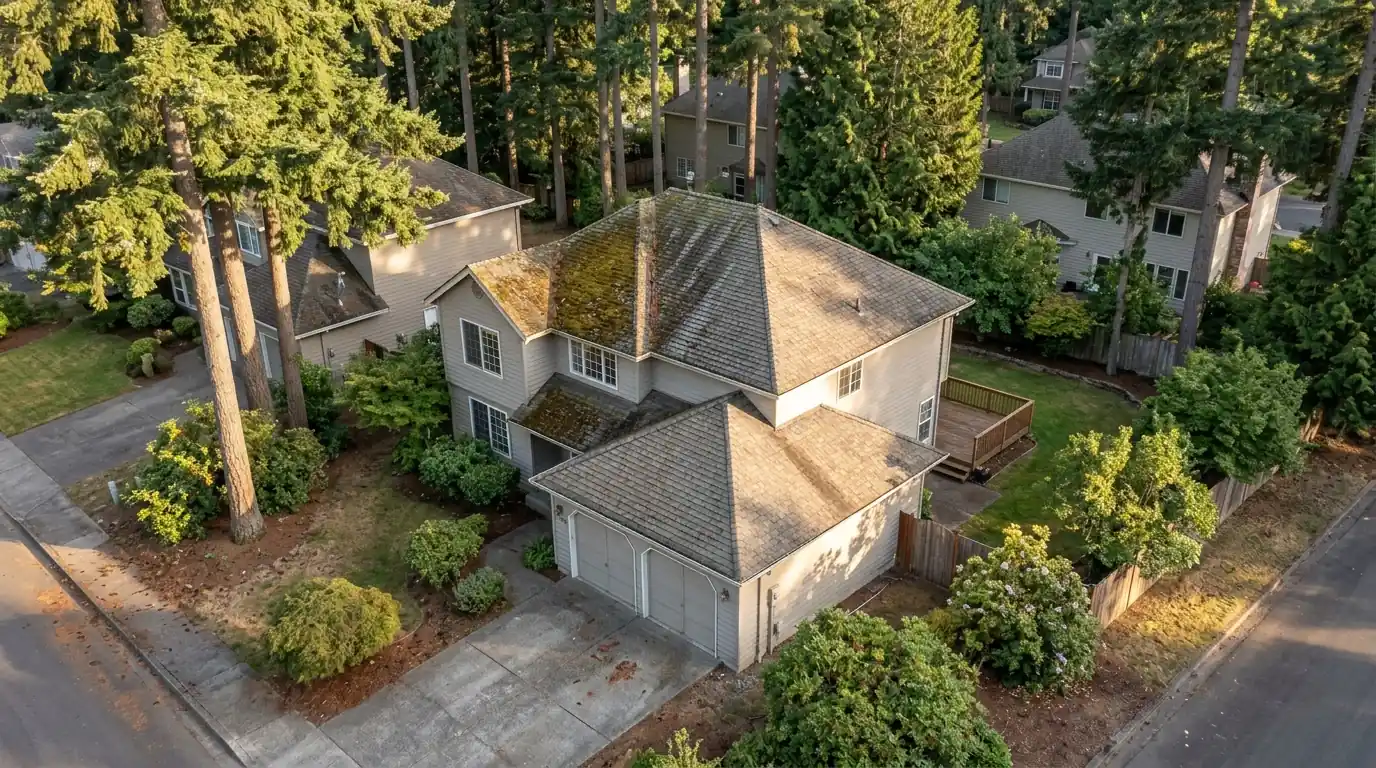
Most roofs in Vancouver and the rest of the Portland metro do not wear out from age alone. They wear out from water that never fully dries, shade that feeds moss, and a few hard east wind events that loosen what sun and rain have already softened. That is why two houses built the same year on the same street can need new roofs ten years apart. The numbers below are typical ranges for our climate, not promises, and the condition of your own roof matters more than the calendar.
We also cover the signs that a roof is near the end, the habits that stretch its life, and when a repair still makes sense. If you are buying a home, planning a sale, or simply wondering how many winters the current roof has left, this gives you a realistic starting point before anyone sets up a ladder.
Typical lifespans by material in our climate
Architectural composite shingles, the most common roof on Clark County homes, usually give 20 to 30 years here when they go over a well-vented attic. Older three-tab shingles tend to land closer to 15 to 20, and they lose tabs in wind sooner as they age. Standing seam metal often lasts 40 years or more, and stone-coated steel is not far behind. Concrete tile can outlast many other parts of the house, but the underlayment beneath it usually needs replacing long before the tiles do. Cedar shake has the widest spread of all: a thick shake roof in full sun can run a long time, while thin shakes under firs may fail early.
Low-slope membranes over porches, additions and flat garage roofs are their own category. A TPO or torch-down section often lasts 18 to 25 years if water drains off it and nobody walks on it much. Ponding water shortens that number fast. Keep in mind that manufacturer warranty terms vary by product and say little about real life on a shaded lot. A shingle sold for a long term can still wear out early if the attic traps moisture or the valleys stay packed with needles every winter.
- Three-tab composite: about 15 to 20 years
- Architectural composite: about 20 to 30 years
- Standing seam metal: often 40 years or more
- Concrete tile: tiles last decades, underlayment much less
- Low-slope TPO or torch-down: about 18 to 25 years
Why the same roof ages faster on one side
Walk around almost any house in Felida or Cascade Park and the north slope will look older than the south slope, even though both went on the same week. The north side gets little sun from October through May, so it stays damp for days after each rain. Moss and lichen settle in, granules soften, and the shingle edges start to curl. The south side has the opposite problem in summer. Strong afternoon sun bakes the asphalt, dries out its oils, and makes shingles brittle sooner, especially on dark colors.
Trees decide a lot. A roof under tall Douglas firs gets a steady rain of needles that pack into valleys and behind chimneys. Those wet piles hold water against the shingles and the flashing, and that is where many roofs fail first. Wind exposure matters too. Homes on open lots in east Vancouver, Camas and Washougal take the brunt of Gorge east winds, and every gust that lifts a tab weakens the seal strip a little more. After enough winters, those tabs stop resealing at all.
Signs a roof is getting close to the end
Some warning signs show up from the driveway with a pair of binoculars. Look for shingles that curl at the corners or cup in the middle, bare patches where granules have washed away, and a ridge line that looks wavy instead of straight. Check the downspout outlets after a rain. A pinch of granules is normal on a newer roof, but heavy gravel-like piles on an older roof mean the surface is wearing through. Thick moss mats on more than one slope usually point to shingles that have been staying wet for years.
The attic tells the rest of the story. On a cold morning, use a flashlight to look at the underside of the roof deck. Dark stains around nails, soft or warped sheathing, and daylight around vent pipes all point to a roof that is letting water or air through. A musty smell in late winter is another clue. One or two of these signs might call for a repair. Several of them together, on a roof past 20 years, usually mean it is time to plan a replacement.
- Curled, cupped or cracked shingles
- Heavy granule piles at the downspouts
- Moss mats covering large areas
- A wavy or sagging ridge line
- Dark stains or soft spots on the attic deck
Habits that add years to a roof
The cheapest way to extend a roof's life is to keep it dry between storms. That means clearing valleys and gutters at least once in fall, and again in late winter if firs hang over the house. It means treating moss before it lifts shingle edges, using gentle methods instead of a pressure washer that strips granules. It also means fixing small things quickly: a cracked pipe boot, a missing ridge cap after a windstorm, or a loose piece of step flashing. Each of those lets water reach the deck, and wet decking shortens the life of everything above it.
Ventilation is the habit nobody sees. An attic with blocked soffit vents or too few exhaust vents traps warm, moist air from the house. In winter that moisture condenses on the cold deck, and over the years the sheathing softens and the nails rust. Good airflow keeps the deck dry and helps shingles age evenly. Trimming branches back from the roofline helps as well. Less shade means faster drying, fewer needles in the valleys, and fewer limbs scraping shingles during a windy night.
Repair or replace: how we help you decide
A roof with one bad spot and sound shingles everywhere else needs a repair, not a replacement. A roof with failing shingles on every slope is the opposite, and patching it just moves the next leak a few feet over. The hard cases sit in the middle: a 20-year-old roof with a leak at the chimney and moss on the north side, for example. In those cases we look at the deck from the attic, check how well the shingles still bend without cracking, and tell you plainly how many more winters we think it has.
Cost matters in that decision. A flashing repair that runs $465 to $1,180 can make sense on a roof with eight good years left. Spending several thousand on repairs to a roof with two years left usually does not. We put both options in front of you with typical ranges, and the real number comes after we look at the roof in person. If you are selling, an inspection on record helps buyers trust what they see instead of guessing at the roof's age.
The short version
- Architectural shingles typically last 20 to 30 years here, but shade, moss and wind can cut that short.
- The north slope and the valleys under firs usually show wear first, so check them before judging the whole roof.
- Keeping the deck dry with clear valleys, moss control and good attic airflow adds more years than any product upgrade.
Leroy Swanson edits the Roofing Library for Roof Down Remodels, turning what our crews see on Clark County and Portland-area roofs into plain guides for homeowners.