A stain on the ceiling near an exterior wall sends most people looking at the roof. Sometimes the roof is fine and the water came in through the wall, right where the roofline meets the siding. These roof-to-wall joints are among the most common leak spots we find in Vancouver, especially on two-story homes with a porch roof, garage roof or bay window tucked against the upper wall. The flashing there has to work with the siding, not just with the shingles.
This post walks through the places where roofs and walls meet, the flashing parts that keep water out, and what tends to go wrong. It also covers why fixing these leaks often means pulling a few courses of siding, and why sealant alone rarely holds through a full wet season in our climate.
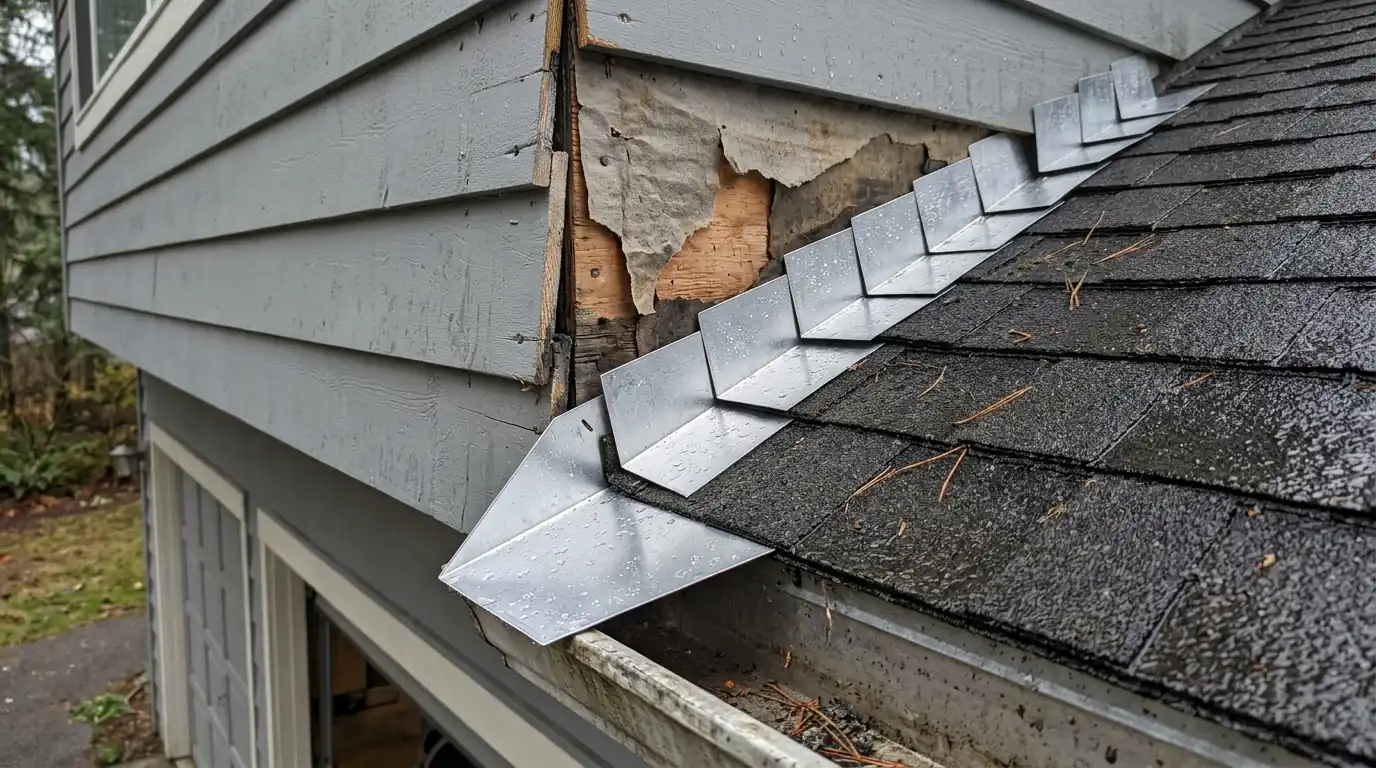
Where roofs meet walls
Any spot where a sloped roof runs into a vertical wall needs flashing that sends water back onto the shingles. The most common is a lower roof along the side of a second story, like a garage roof against the main house in Fishers Landing or Orchards. Others include dormer sidewalls, the top edge of a porch roof where it meets the house, the high wall of a shed-roof addition, and chimneys clad in siding instead of brick. Each of these joints takes a lot of water, because the upper wall sheds rain straight down onto it.
The trouble is that these joints belong to two trades at once. The roofer installs the flashing, and the siding has to lap over it the right way. When either one is done out of order, water can run behind the siding and down the inside of the wall. On homes from the 1980s and 1990s, we often find flashing that was tucked under the siding in some spots and nailed on top in others, with caulk filling the gaps. That caulk usually cracks within a few winters.
The flashing parts that do the work
Step flashing is a series of small bent pieces, one for each course of shingles, that run up a sidewall. Each piece laps over the one below, so water stays on top. The siding or a housewrap layer then laps over the vertical leg. Headwall flashing sits where the top of a lower roof meets a wall straight across. It turns up the wall and lies over the top course of shingles. Counterflashing covers the upper edge on brick or stucco surfaces, where siding cannot lap over anything.
The part that causes the most trouble is the kickout flashing. It sits at the bottom of a roof-to-wall joint, right where the roof edge ends against the wall, and it turns water out into the gutter instead of letting it run down the face of the siding. Without one, water pours behind the trim and into the wall framing every time it rains. Many older Clark County homes never had kickouts, and the damage often hides behind the siding until the wood is soft.
- Step flashing: one piece per shingle course along a sidewall
- Headwall flashing: where a lower roof meets a wall straight across
- Kickout flashing: turns water into the gutter at the bottom of the joint
- Counterflashing: covers flashing on brick, stone or stucco
Signs the leak is in the wall, not the roof
Wall leaks leave a different trail than roof leaks. Look for staining that starts at the top of an exterior wall and runs down, peeling paint on the siding just below a roof edge, or swollen trim boards near the bottom corner of a lower roof. Inside, check for bubbling paint low on a wall, damp carpet along a baseboard, or a musty smell in a closet that backs up to the garage roof. These clues point to water getting behind the siding, often well away from where it first entered.
Timing helps too. Water that only gets in during a hard east wind or sideways rain is often being driven past a short piece of step flashing or a gap where siding meets the roof. A leak that shows up in every long rain suggests missing kickout flashing or a failed headwall piece that collects water each time. The leak finder tool on this site walks through these patterns. A quick look from the ground with binoculars can also show missing kickouts, or caulk smeared where metal should be.
Why fixing it often means pulling siding
Done right, roof-to-wall flashing sits behind the siding. That means repairs usually start by removing the lowest few courses of siding along the joint, along with any trim boards in the way. With the siding off, we can see whether the step flashing is complete, whether the housewrap laps over it, and whether the wall sheathing has rotted. Sealing the outside edge with more caulk skips all of that, and in a climate with eight wet months, it rarely holds for long.
When the siding comes off, we often find soft sheathing near the bottom corner of the joint. That wood gets replaced, new step and kickout flashing go in, and the housewrap is lapped back over the top. Then the siding goes back on, either the original pieces if they come off clean or matching new boards if they are cracked or rotted. Fiber cement and wood lap siding can usually be matched. Older vinyl can be harder, and we tell you before work starts if a close match may not be available.
Typical repair costs
A single sidewall flashing repair with a small amount of siding removal, such as a garage roof meeting the house, often runs $685 to $1,940 in the Vancouver area. Adding a missing kickout is usually part of that job rather than a separate line. When the sheathing behind the joint is rotted, costs climb, since the damaged wood has to come out and be replaced before new flashing goes in. Longer joints, two-story ladder work and specialty siding push the number up. These are typical ranges, and the real number comes after we look at the roof and wall.
If the siding near the joint is already failing, it can make sense to replace a section of siding while the flashing is open. That keeps the wall from being opened twice. We look at the whole wall, explain which parts need work now and which can wait, and price both. A photo log of what we found behind the siding comes with every job, so you can see the condition of the sheathing yourself. That record also helps if you sell the house later.
The short version
- Many leaks near exterior walls start at roof-to-wall joints, not in the open field of the roof.
- A missing kickout flashing at the bottom of a sidewall is one of the most common causes of hidden wall rot.
- Lasting repairs usually mean pulling a few courses of siding, not adding more caulk on the outside.
Leroy Swanson edits the Roofing Library for Roof Down Remodels, turning what our crews see on Clark County and Portland-area roofs into plain guides for homeowners.