Solar panels sit on a roof for a long time, and most systems are expected to outlast the shingles under them. That mismatch catches a lot of homeowners off guard. If the roof needs replacing five years after the panels go up, the whole array has to come off, be stored, and go back on. Getting the order right saves money, and it keeps the roofing terms and the solar terms from pointing at each other when something leaks.
This post covers two situations: adding solar to a roof that is already aging, and reroofing a house that already has panels. In both cases the roofing work and the electrical work belong to separate trades. We handle the roof, the mechanical removal and reinstall of panels and racking, and the flashing at every mount. The electrical disconnect and reconnect, where required, belongs to a solar or electrical pro.
Check the roof before the panels go on
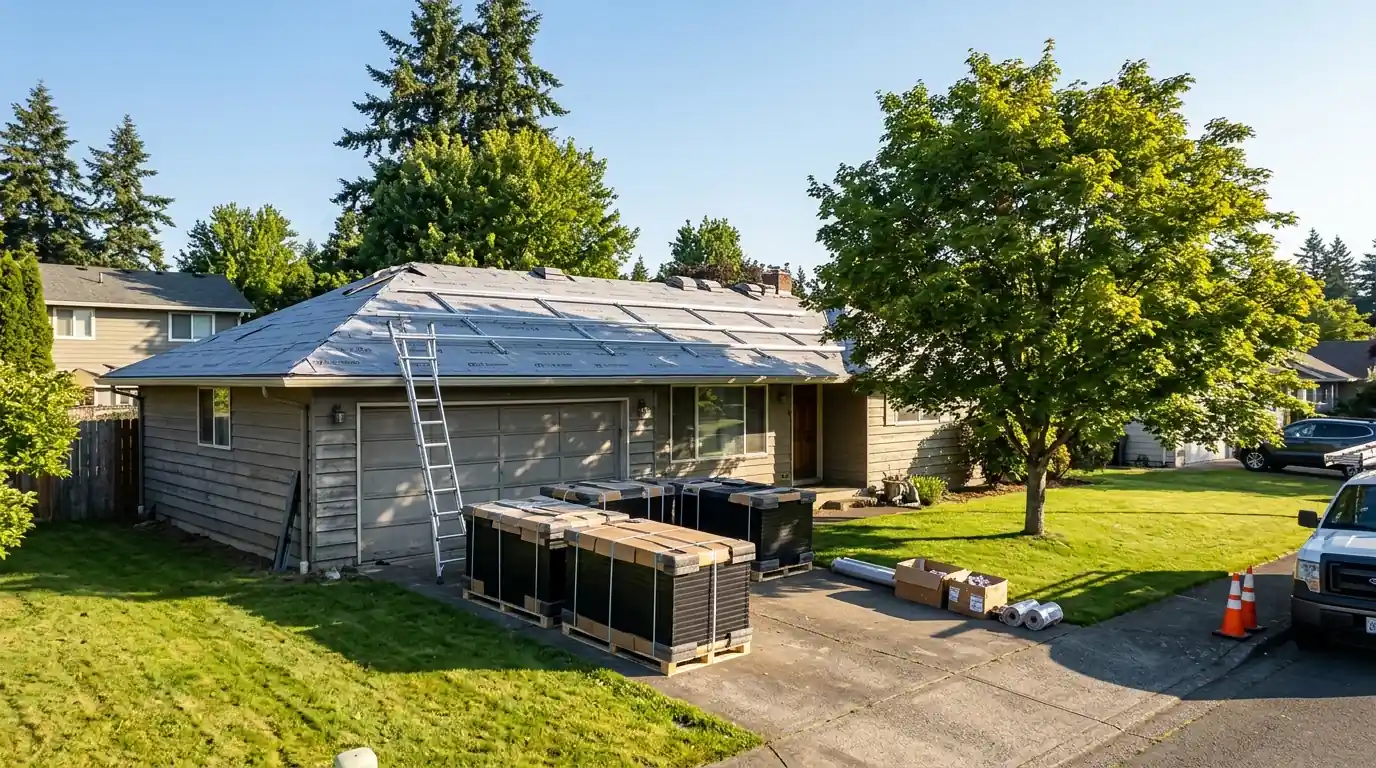
If you are collecting solar quotes, ask how old the roof is before you sign anything. A composite roof with 15 years on it in our wet climate may have only a few good winters left, and the array will likely last much longer than that. Putting new panels on a tired roof means paying to remove and reinstall them later, often within the first third of the system's life. A short roof inspection before installation tells you whether the shingles, decking and flashing can carry the array for the long haul.
When the roof is close, reroofing first usually makes sense. The solar installer then mounts to fresh shingles and solid decking, and the attachment points get sealed into a new roof instead of an old one. If only part of the roof is worn, sometimes the panel slopes can be replaced while the rest waits. We look at which faces the array will cover, usually the south and west slopes, and tell you honestly how much life those faces have left.
What removal and reinstall actually involves
On a reroof, the array comes off before tear-off starts. The system is shut down and electrically disconnected by a solar or electrical pro where required, then the panels are unbolted from the racking, labeled by position, and stored safely on the ground or in a garage. The rails and mounts come off next. Every roof penetration left behind gets marked, so the new attachment points line up with rafters and get proper flashing instead of a dab of sealant.
After the new roof goes on, the mounts are reattached with flashed footings, the rails are leveled, and the panels go back in their original layout. The electrical reconnection and system check are handled by the solar or electrical pro, and the owner or monitoring company confirms the system is producing. Timing matters here. We plan the removal date, the reroof and the reinstall together, so the house is not left without solar production longer than needed and the array never sits waiting over an open deck.
- Electrical disconnect by a solar or electrical pro where required
- Panels unbolted, labeled by position and stored
- Racking and mounts removed, penetrations marked
- New roof installed with flashed attachment points
- Panels and rails reinstalled, then electrical reconnect and system check
Who to call, and in what order
Call the company that owns or services the solar system first. If you lease the panels or have a power purchase agreement, the system belongs to someone else, and their contract usually spells out who may touch it. Some leasing companies insist on sending their own crew. Others approve outside roofers for the mechanical work. If you own the system outright, check what the installer's workmanship terms say about removal by others, since some terms change once the array has been moved.
Then call us. We coordinate dates with the solar owner or installer, confirm who handles the electrical disconnect and reconnect, and line up the reroof so the crews are not tripping over each other on the same day. One call to each party is usually enough to set the plan. Keep copies of every agreement and the original installation paperwork. They help later if anyone asks when the panels were moved, who moved them, and what the roof looked like underneath.
Leaks around solar mounts
Not every solar leak means the roof is failing. Many leaks under arrays start at a single mount where the flashing was skipped, the sealant dried and cracked, or a lag bolt missed the rafter and split the decking. In a wet Vancouver winter, a small gap at one footing can soak a ceiling over a few weeks before anyone notices. The stain often shows up a few feet downslope from the mount, since water travels along the underlayment before it finds a way in.
Fixing a mount leak usually means removing the panel above it, pulling the footing, repairing any soft decking, and installing a flashed mount in its place. That is careful work, and it still needs the electrical side handled correctly before any panel comes off. Needles and moss also collect under arrays because the gap stays shaded and damp. A roof under panels deserves a look during regular gutter cleaning, with a check for debris dams on the uphill side of each row.
Typical costs and how to plan the budget
Removal and reinstall is priced by the size of the array, the roof pitch and the racking type. For a typical home system in the Vancouver area, the roofing side of a removal and reinstall often runs $2,365 to $5,840, separate from the reroof itself. The electrical disconnect and reconnect by a solar or electrical pro is billed on top of that. Larger arrays, steep roofs and older racking that needs new parts all push the number higher. These are typical ranges, and the real number comes after we look at the roof and the array.
Plan the reroof and the solar work as one project with one schedule, even if two companies send invoices. Ask each party for a written scope that lists what they handle and what they do not. If the roof is near the end and you are only now adding solar, budgeting for a reroof first often costs less over the life of the system than paying for a removal and reinstall a few years in. We walk through both paths with numbers before you commit.
The short version
- If the roof under a planned array has fewer than about ten good years left, reroofing first usually saves money.
- Roofers handle the mechanical removal, reinstall and flashing, while a solar or electrical pro handles electrical disconnect and reconnect.
- Call the solar owner or installer first, then schedule the roof so both crews work from one plan.
Leroy Swanson edits the Roofing Library for Roof Down Remodels, turning what our crews see on Clark County and Portland-area roofs into plain guides for homeowners.