Some leaks are steady and easy to trace. Others only show up when a big atmospheric river parks over the Portland metro and dumps rain for a day or two straight. The ceiling stays dry through weeks of normal drizzle, then a brown ring appears overnight. Homeowners often assume the roof has a hole somewhere. More often, the roof sheds normal rain just fine and fails only when the volume of water overwhelms one weak spot.
Knowing that pattern narrows the search a lot. Heavy-rain leaks almost always come from places where water collects and moves fast: valleys, gutters, low-slope sections, flashing at walls and chimneys, and the spots where debris builds up. This post walks through each one and what you can check before calling.
Why volume matters more than duration
A roof is built in overlapping layers. In light rain, water runs down the surface, over each shingle, and into the gutters without ever reaching the laps underneath. In a downpour, the amount of water moving across the roof at once can be many times higher. It backs up behind anything in its path, spreads sideways at the seams, and climbs under laps that would never see water in a drizzle. A tiny gap in flashing that stays dry for months can let in a steady stream when the flow is heavy enough.
That is also why heavy-rain leaks seem random. They might appear twice one winter and not at all the next, depending on how many big storms arrive. The leak is real, though, and each event soaks a little more of the decking and insulation. Rot often starts long before the ceiling stain does. A stain that dries and fades is still a sign that water got in and that wood under the roof spent hours wet. Treat it as a repair to schedule, not something to wait out.
Valleys and the water that pours through them
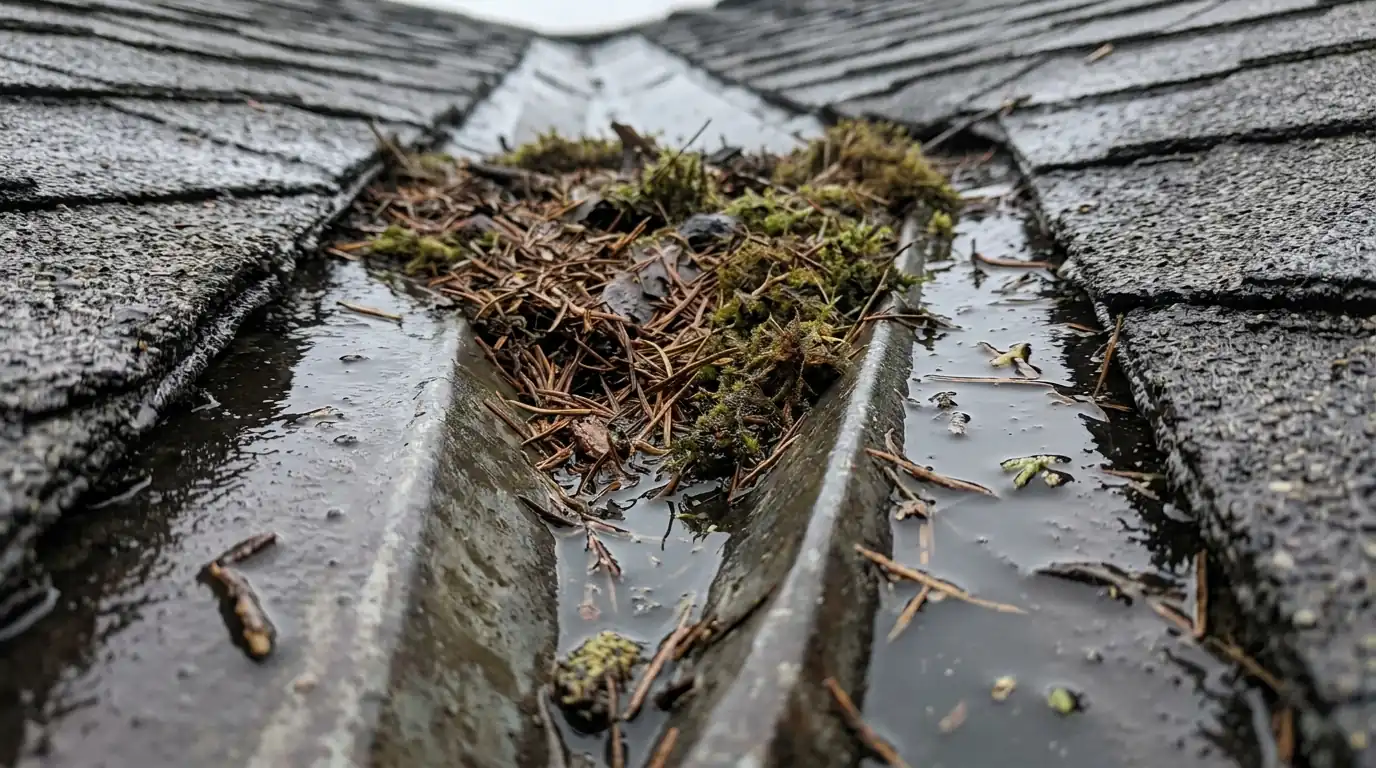
A valley is where two roof slopes meet in an inside corner, and it carries the runoff from both. On a cut-up roof with several valleys, those channels move a huge share of the water during a downpour. If the valley has worn shingles, a cracked or rusted metal liner, or nails driven too close to the center, heavy flow can find its way underneath. Debris makes it worse. Fir needles and moss pile up in valleys here and act like small dams, pushing water sideways under the shingles.
Valley leaks tend to show up as stains in a line below the valley, sometimes far from where the water first gets in, because it runs along the decking before dripping. From the ground, look for valleys with dark streaks, heavy needle buildup, or shingles that look curled or cracked along the center line. In the attic, follow the valley rafters with a flashlight after a storm. Water stains on the wood often lead straight to the weak spot, even if the ceiling stain is a few feet away.
Gutters that overflow at the eave
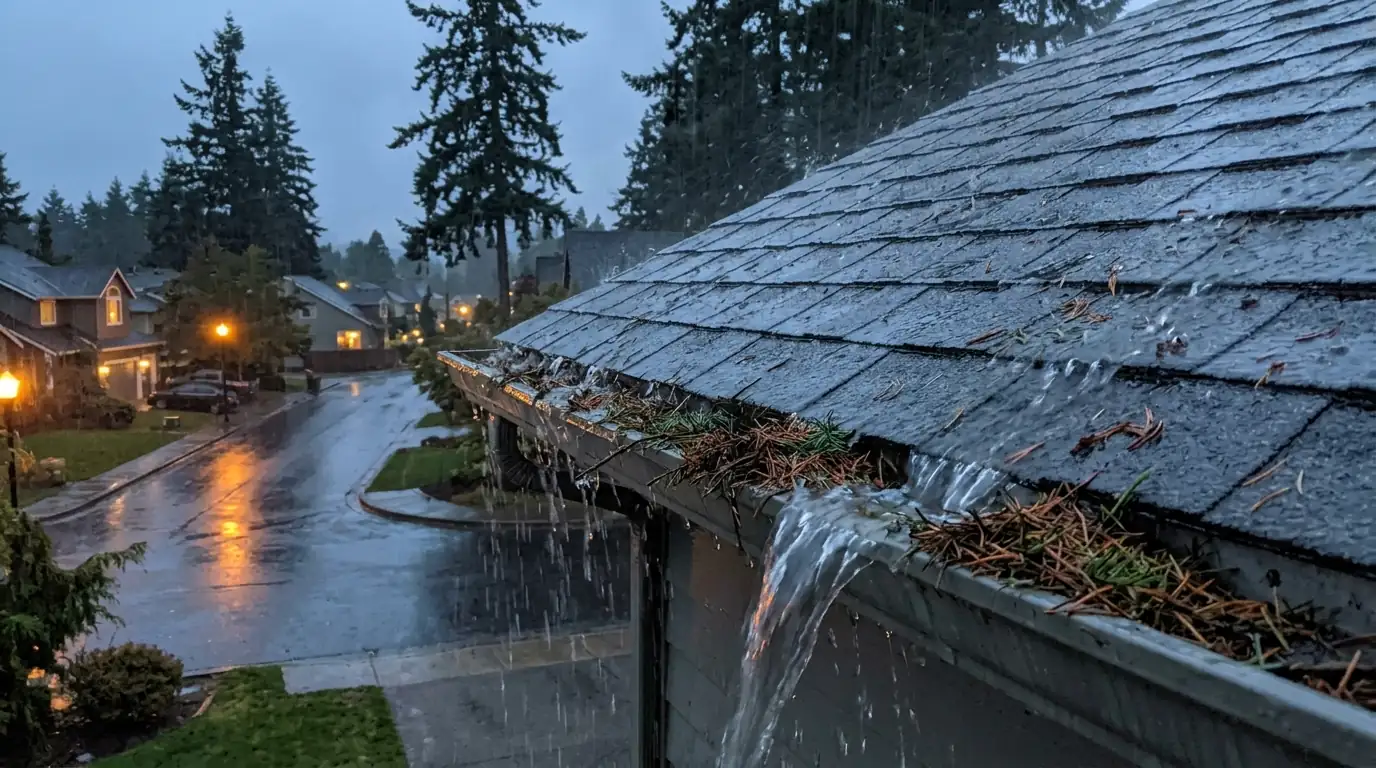
Many heavy-rain leaks are not roof leaks at all. When gutters clog with needles, moss, or maple seeds, or when downspouts are too small for the roof area they serve, water spills over the back of the gutter during a downpour. It runs behind the gutter, soaks the fascia board, and can wick up under the first course of shingles and into the wall. Inside, this usually shows up as a stain at the top of an exterior wall or a damp spot near a window head.
Watch your gutters during the next hard rain if you can do so safely from the ground. Water sheeting over the front or pouring behind the gutter is a clear sign. Look for gutters pulled away from the fascia, sagging sections, or downspouts that dump water against the foundation. Clean gutters before the rainy season and again after fall needle drop. If a long roof drains into a single downspout, a second outlet or a larger downspout may solve the problem without touching the roof at all.
Flashing at walls, chimneys and skylights
Any place where the roof meets something that sticks up needs metal flashing to direct water around the joint. Chimneys, skylights, dormer walls, and the spot where a lower roof meets a two-story wall all depend on it. Flashing that was installed without enough overlap, sealed only with caulk, or bent during past repairs can hold up in drizzle and fail in a downpour. The uphill side of a chimney is a classic problem, since water piles up there and needs a cricket or saddle to split the flow.
Signs include stains on the ceiling or wall right next to a chimney, around a skylight well, or below a roof-to-wall joint. From outside, look for dried caulk, rusted or lifted metal, and missing kick-out flashing where a roof edge ends against a wall. Kick-out flashing is a small bent piece that steers water into the gutter instead of down the siding. When it is missing, heavy rain can run straight into the wall behind the siding and cause rot that stays hidden for years.
- Stains next to a chimney, often worst on the uphill side
- Damp drywall around a skylight well after storms
- Wall stains below a roof-to-wall joint
- Missing kick-out flashing at the bottom of a sidewall
- Cracked caulk standing in for real metal flashing
Low-slope sections and porch roofs
Many Vancouver homes have at least one low-slope area: a back porch roof, a sunroom tie-in, a shed dormer, or a flat section over an addition. These areas drain slowly even in good shape. If someone used regular shingles on a slope that is too flat for them, or if the membrane has a seam that has opened, a heavy rain will find it. Water that would run right off a steep roof can sit long enough on a low slope to work its way through any weak spot.
Inside, these leaks often appear on a porch ceiling, in the room under an addition, or along the wall where the low roof meets the main house. Outside, look for ponding water that remains a day after rain, shingles on a nearly flat slope, or membrane seams that look lifted or wrinkled. Fixing it may mean redoing that section with a proper low-slope membrane, such as torch-down or another flat-roof system, rather than patching shingles that never belonged there. The fix lasts far longer.
What to do before the next storm
When the leak appears, catch the water, move belongings, and if the ceiling is bulging, poke a small hole at the low point to let water drain into a bucket so the drywall does not collapse. Take photos inside and out with the date. Then, once the rain eases and it is safe, look at the gutters, valleys, and flashing from the ground. Do not climb on a wet roof. Many slips and falls happen exactly when someone tries to find a leak in the rain.
Note when the leak started, how heavy the rain was, and which way the wind was blowing. That information helps a lot when we look for the source, because it tells us whether the problem is volume, wind direction, or something else. If another big storm is forecast, a tarp over the suspect area can hold off damage until a repair is done. We handle emergency tarping any time of day, then come back to make the real repair once the weather allows.
The short version
- A leak that appears only in downpours usually comes from valleys, gutters, flashing, or low-slope sections, not a hole in the field of the roof.
- Clogged gutters and missing kick-out flashing cause many leaks that show up at the top of exterior walls.
- Record when and how the leak happens, because those details point straight to the source.
Leroy Swanson edits the Roofing Library for Roof Down Remodels, turning what our crews see on Clark County and Portland-area roofs into plain guides for homeowners.